
How to become a safari tracker: training, levels and jobs
Tracker Academy takes 24 students a year from hundreds of applicants, and CyberTracker evaluations grade trackers from Level 1 to Senior Tracker.
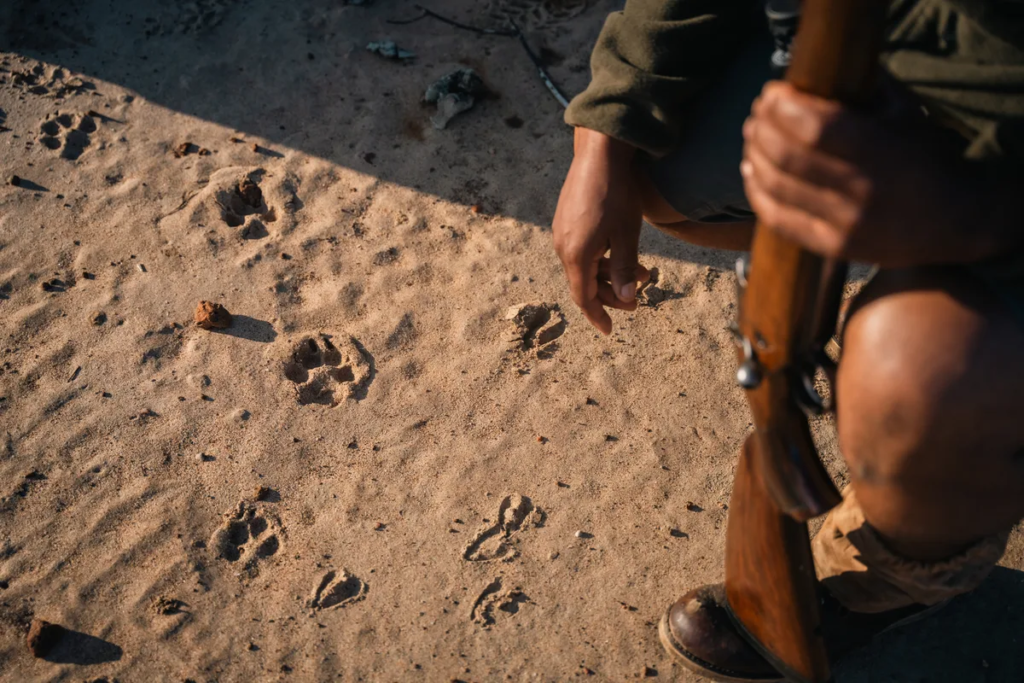
To become a tracker at a safari lodge in South Africa, most people either do Tracker Academy’s one-year Lodge Tracker course (NQF2) or start at a lodge in another job and learn from its trackers, then prove their skill through tracker evaluations: Track and Sign plus Trailing, scored in levels from 1 to Professional and then Senior Tracker. Lodge ads ask for a tracking qualification, a driving licence and often a PrDP. Many trackers later become guides.
We built this from Tracker Academy’s own pages and annual report, the CyberTracker and FGASA rules for evaluations, lodge publications and recent ads. What the guide does on the same vehicle is covered in what does a field guide do.
The seat in front of the guide
At Singita’s South African and Zimbabwean lodges, each tracker works as a pair with one field guide. Singita describes the tracker reading how old a track is, what the animal was doing and how old a kill is, and using that to find game and explain behaviour. One of its trackers, Johnson Mhlanga, started out clearing bush at a lodge, began working towards his tracking qualification in 2001 and joined Singita in 2003.
A 2021 Londolozi post shows how a sighting is found. Tracker Freddy Ngobeni, sitting in the seat in front of the guide, raised his hand to stop the vehicle at lion tracks crossing the road. The guests waited in the vehicle under a marula tree while tracker and guide followed the spoor on foot, reading flattened grass, broken twigs and prints in bare soil, until they found the pride a couple of hundred metres away. Then they walked back and drove the guests in.
The best trackers set a high bar. Londolozi’s Richard Siwela tracked leopard every day for 42 years, with a success rate of about 70% at his peak, against 22% for Tracker Academy’s top students, according to a 2021 post by Alex van den Heever. Ads add the rest of the job. A May 2024 MORE Family Collection ad for a Kruger tracker listed game drives, bush walks, spoor identification, setting up drinks stops, back-up and standby drives, guest transfers and luggage. It asked for matric or an NCV, a tracking qualification, a driving licence and a valid PrDP.
Tracker Academy: 24 places a year
Tracker Academy is run by the SA College for Tourism, which lists its address in Graaff-Reinet, and its courses are accredited by CATHSSETA and endorsed by FGASA. Training happens on partner reserves: its 2022 report named Tswalu, Samara, Lapalala and Londolozi, a camp at the Southern African Wildlife College, and andBeyond’s Ngala concession.
| Course | Level | Length | What it adds |
|---|---|---|---|
| Lodge Tracker | NQF2, 66 credits | 1 year, full-time | Track and sign, trailing, walking near dangerous animals, nature guiding, firearm competency |
| Conservation Guardian Tracker | NQF4, 72 credits | 1 year, full-time | Man-tracking, rhino monitoring, law enforcement, firearms, PSIRA E, D and C security grades |
| Lead Tracker | NQF4, 65 credits | 1 year, part-time | Trailing lion and leopard, bird alarm calls; by invitation, for trackers with over 10 years in the field |
The academy says it gets hundreds of applications a year and takes 24 students in three intakes of 8. Applications open in March for the June intake and September for the January intake. Its criteria ask for disadvantaged, unmarried applicants (the page gives the age range as both 21 to 35 and 21 to 31), matric, a SAPS police clearance, good spoken and written English and willingness to live away from home for 12 months. Students take a polygraph test at the start. Applicants can apply for a training bursary, but the academy says to budget about R4,000 for travel and personal items, plus at least R200 a month for toiletries.
The results are published. In 2022, 23 sponsored students passed, 17 of them at Tracker Level 3 and 6 at Level 2. The academy reports that 93% of its graduates since 2010 have found work, 54% in ecotourism and 24% in counter-poaching units. Londolozi says Tracker Academy graduates make up a large part of its tracking team.
How tracker evaluations are scored
The evaluations come from CyberTracker, a South African non-profit. Track and Sign tests you on at least 35 tracks and signs; Trailing has you follow an animal’s trail and scores how you do it. Your tracker certificate is set by the lower of the two scores, so a Level 3 in Track and Sign with a Level 2 in Trailing makes you a Tracker 2.
| Level | Score needed in both | Typical experience (CyberTracker guide) |
|---|---|---|
| Tracker 1 | 70% | About 1 year |
| Tracker 2 | 80% | About 2 years |
| Tracker 3 | 90% | About 3 years |
| Professional Tracker | 100% | About 4 years |
| Senior Tracker | 100% on the Specialist evaluations: 50 very difficult signs, a hard trail such as lion or leopard, and oral tests | About 5 years |
| Master Tracker | Not an evaluation: an honorary award to Senior Trackers, normally with 15 years’ experience, 10 of them as Senior Tracker | 15 years or more |
Master Trackers are rare. CyberTracker lists 17, plus 19 Indigenous Master Trackers, and the most recent South Africans named are from the Greater Kruger, including Ekson Ndlovu and Lee Gutteridge in 2024.
Where FGASA fits
FGASA does not issue tracking certificates itself. You book and pay for a Track and Sign and a Trailing assessment with a tracking trainer or assessor on its list of specialist delivery partners, and your tracker level follows from the two results. Its highest tracking title, Scout, combines Senior Tracker with its dangerous game trails qualification. Tracking also matters on the guiding side: FGASA’s Trails Guide qualification at NQF4 requires Tracker 1, as our trails guide article explains.
From the tracker seat to the driver’s seat
People come into tracking from other lodge jobs, and many move on to guiding. Robert Hlatshwayo joined Londolozi in 2009 as a security guard at the boom gate, went to Tracker Academy in 2010 and was tracking at Londolozi by 2011. Sipho Sibuyi trained as a tracker after school, took his first lodge job in 1999, joined Singita Lebombo in 2002, was invited onto Singita’s field guiding course in 2006 and came back as a guide in 2007.
Tshuxekani “Cruz” Gumede shows a faster route. After a bursary at MORE’s field guide college he interned at Lion Sands, was hired as a tracker in 2022, earned CyberTracker Tracker 3 and was made a full-time guide later that year. He passed his FGASA NQF4 practical in December 2023 and then qualified as a trails guide. To make the move you need the guiding basics on top of tracking: NQF2, first aid, a PrDP and tourist guide registration, set out in FGASA levels explained.
Tips, but no published salaries
We found no recent tracker ad in South Africa or elsewhere that stated a salary. Tips are the one published guide to the gap with guides. Southern Destinations, a tour operator, suggests guests tip trackers US$8 to US$10 per guest per day at standard 4 and 5-star lodges, against US$18 to US$20 for the guide, and from US$20 for trackers at the most expensive lodges. For what guides earn, see our field guide salary article. Tracker posts appear with guiding vacancies on our field guide jobs page.
This article sums up training providers’ pages, evaluation rules, lodge publications and job ads as they stood in October 2026. Intake dates, entry criteria and evaluation rules change, so check with Tracker Academy, FGASA or the employer before you apply.
Sources
- Singita, expert trackers (Dec 2022): singita.com
- Londolozi, tracking with Freddy (Jan 2021): blog.londolozi.com
- Londolozi, the original leopard trackers (Feb 2021): blog.londolozi.com
- MORE Family Collection, Tracker, Kruger Park (May 2024): myjobmag.co.za
- Tracker Academy, courses: trackeracademy.co.za/courses
- Tracker Academy, how to apply: trackeracademy.co.za/apply-now
- Tracker Academy, about and accreditation: trackeracademy.co.za
- Tracker Academy, final report (Dec 2022): trackeracademy.co.za
- CyberTracker, tracker evaluations (Jul 2012): cybertracker.org
- CyberTracker, Master Trackers: cybertracker.org
- FGASA, Track and Sign and Trailing certificates (2023): fgasa.co.za
- FGASA, Trails Guide (VPDA) NQF2 and NQF4 (Oct 2025): fgasa.co.za
- Londolozi, trackers taking the lead (Aug 2014): blog.londolozi.com
- Singita, Sipho Sibuyi profile: singita.com
- FGASA, Cruz Gumede’s path to trails guide (Feb 2025): fgasa.co.za
- Southern Destinations, tipping guidelines (updated Jul 2026): southerndestinations.com